
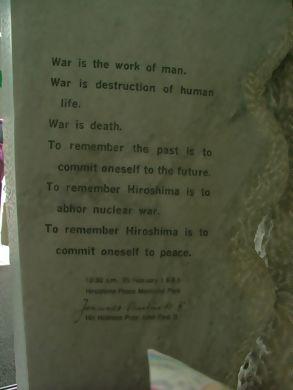
T oday at exactly 8:15 AM, the first used of the atomic bomb happened in Hiroshima 60 years ago.
About an hour before the bombing, the Japanese early warning radar net detected the approach of some American aircraft headed for the southern part of Japan. The alert had been given and radio broadcasting stopped in many cities, among them Hiroshima. The planes approached the coast at a very high altitude. At nearly 08:00, the radar operator in Hiroshima determined that the number of planes coming in was very small—probably not more than three—and the air raid alert was lifted. The normal radio broadcast warning was given to the people that it might be advisable to go to shelter if B-29s were actually sighted, but no raid was expected beyond some sort of reconnaissance. At 08:15, the B-29 Enola Gay, piloted and commanded by Colonel Paul Tibbets, dropped the nuclear bomb called "Little Boy" over the central part of the city and it exploded about two thousand feet above the city with a blast equivalent to 13 thousand tons of TNT.
The atomic bomb called "Little Boy" was dropped over the central part of the city and the bomb exploded with a blast equivalent to 12,000 tons of TNT, killing 80,000 people outright.
By the end of 1945, an estimated 60,000 more people died due to nuclear fallout sickness. However, this total does not include longer term casualties from radiation exposure.

"Little Boy" is the nick name given to the atomic bomb dropped on Hiroshima on August 6, 1945. It was Monday morning. Little Boy was dropped from the Enola Gay, one of the B-29 bombers that flew over Hiroshima on that day. After being released, it took about a minute for Little Boy to reach the point of explosion. Little Boy exploded at approximately 8:15 a.m. (Japan Standard Time) when it reached an altitude of 2,000 ft above the building that is today called the "A-Bomb Dome."
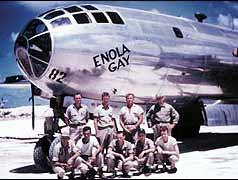
CREW:Col. Paul Warfield Tibbets, Jr., 509th Group CO and pilot
Capt. Robert A. Lewis, co-pilot
Lt. Jacob Beser, radar countermeasure officer

Left to Right,
Standing: Lt. Col. John Porter, ground maintenance officer; Capt. Theodore J. Van Kirk, navigator; Maj. Thomas W. Ferebee, bombardier; Col. Paul Tibbets, pilot and commander of 509th Group; Capt. Robert A. Lewis, copilot; and Lt. Jacob Beser, radar countermeasure officer.
Kneeling:
Sgt. Joseph Stiborik, radar operator; SSgt. George R Caron, tail gunner; Pfc. Richard H Nelson, radio operator; Sgt. Robert H. Shumard, assistant engineer; and SSgt Wyatt Duzenbury, flight engineer. Col. Porter was not on the aircraft during the flight.
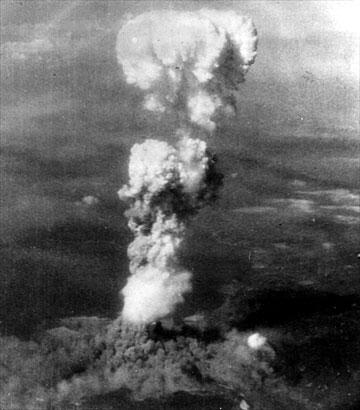

The ruins around the Industrial Promotion Hall, now known as the Atomic Bomb Dome.

A frame of a streetcar, 885 feet (270 meters) east of the hypocenter. The buildings in the distance from left to right, are the Kirin beer hall, a construction company, and a bank.
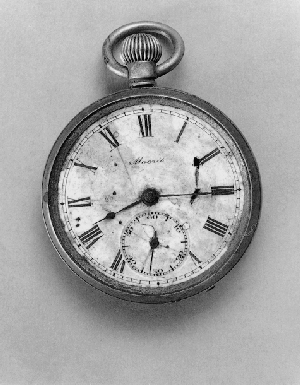
The watch that tells the time the world ended at Hiroshima.
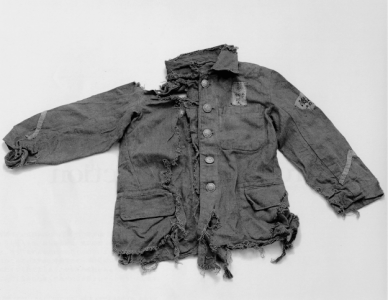
Akio Tsukuda (13 at the time) was engaged in fire prevention work about 800 meters from the hypocenter. His father found his school uniform hanging on a granch of a tree on August 8, 1945. His body was not found.
For more info, see the following sites:
No comments:
Post a Comment